IN 1903, WOMEN DIDN’T WANT TO VOTE
In 1903, Women Didn’t Want to Vote – The Transformed Wife
IN 1903, WOMEN DIDN’T WANT TO VOTE
December 26, 2018 Lori Alexander
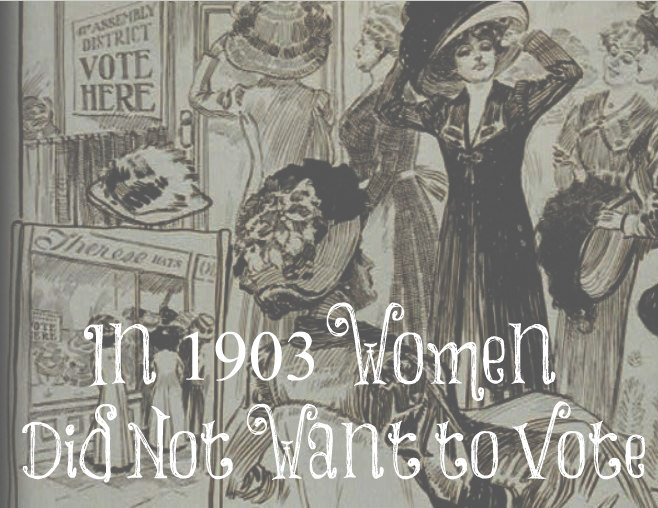
In September of 1903, an article in The Atlantic called Why Women Do Not Wish the Suffrage, the author explains why women didn’t want to vote (only 4 percent wanted to vote in a poll taken). They knew their highest calling was in the home and raising the next generation. They wanted their entire focus to be upon this and not concerned with things that they weren’t involved with like fighting wars, being policemen, or going out and making a living for the family. Oh, how far we have fallen. Now, many mothers do not want to be home full time raising the next generation. They want to be out in the workforce instead and societies have suffered greatly.
Here are some of my favorite excerpts from the article. (My goal in publishing this post isn’t to take a woman’s right to vote away but to give a glimpse into what women were actually fighting for and against in wanting to vote.)
All talk of equality or non-equality is but idle words, without a meaning. Only things which have the same nature and fulfill the same function can be said to be superior to or equal with one another. Things which do not fulfill the same function are not thus comparable. For of two functions, each of which is essential to the life of the organism, neither can be said to be superior to the other.
Man is not an inferior woman. Woman is not an inferior man. They are different in nature, in temperament, in function. We cannot destroy this difference if we would; we would not if we could. In preserving it lies the joy of the family; the peace, prosperity, and well-being of society. If man attempts woman’s function, he will prove himself but an inferior woman. If woman attempts man’s function, she will prove herself but an inferior man. Some masculine women there are; some feminine men there are. These are the monstrosities of Nature.
This distinction between the sexes – inherent, temperamental, functional – is universal and perpetual. It underlies the family, which could not exist if this difference did not exist. It is to be taken account of in all social problems – problems of industrial organization, religious organization, political organization. Should society ever forget it, it would forget the most fundamental fact in the social order, the fact on which is built the whole superstructure of society.
It may not be altogether easy to determine the exact difference in function between the sexes; in minor details those functions may differ in differing civilizations. But speaking broadly, it may be said that the work of battle in all its forms, and all the work that is cognate thereto, belongs to man. Physically and psychically his is the sterner and the stronger sex. His muscles are more steel-like; his heart and his flesh are alike harder; he can give knocks without compunction and receive them without shrinking. In the family, therefore, his it is to go forth and fight the battle with Nature; to compel the reluctant ground to give her riches to his use. It is not for woman to hold the plough, or handle the hoe, or dig in the mine, or fell the forest. The war with Nature is not for her to wage.
But whether it is the Indian squaw digging in the corn patch, or the German Frau holding the plough, or the American wife working the loom in her husband’s place,—wherever man puts the toil that is battle and the battle that is toil upon the woman, the law of Nature, that is, the law of God, written in her constitution and in the constitution of the family, is set at naught.
The question, “Shall woman vote?” is really in the last analysis, the question, “Ought woman to assume the responsibility for protecting person and property which has in the past been assumed by man as his duty alone?” It is because women see, what some so-called reformers have not seen, that the first and fundamental function of government is the protection of person and property, and because women do not think that they ought to assume this duty any more than they ought to assume that police and militia service which is involved in every act of legislature, that they do not wish to have the ballot thrust upon them.
A ballot is not a mere expression of opinion; it is an act of the will; and behind this act of the will must be power to compel obedience. Women do not wish authority to compel the obedience of their husbands, sons, and brothers to their will.
The great elections are called, and not improperly called, campaigns. For they are more than a great debate. A debate is a clash of opinions. But an election is a clash of wills. One party says, “We will have Mr. Blaine President;” the other says, “We will have Mr. Cleveland President.” Will sets itself against will in what is essentially a masculine encounter. And if the defeated will refuses to accept the decision, as it did when Mr. Lincoln was elected President, war is the necessary result.
This is the negative reason why woman does not wish the ballot: she does not wish to engage in that conflict of wills which is the essence of politics; she does not wish to assume the responsibility for protecting person and property which is the essence of government. The affirmative reason is that she has other, and in some sense, more important work to do. It is more important than the work of government because it is the work for the protection of which governments are organized among men. Woman does not wish to turn aside from this higher work, which is itself the end of life, to devote herself to government, which exists only that this higher work may be done. Nor does she wish to divide her energies between the two. This higher work, which is itself the end of life, is Direct Ministry to Life.
What are we in the world for? The family answers the question. We marry. Children are given to us to protect, govern, nurture, train. They grow to manhood, and in turn they marry, and to them in turn children are given to protect, govern, nurture, train. The first parents linger a few years that, as grandparents, they may have the pleasure of the little children without the responsibility for them, and then they die. Their work on earth is done, and they go forward to we know not what work in a life to come. The end of life is the rearing and training of children.
Love is the mainspring of industry. It is love for the home and the wife and the children that keeps all the busy wheels of industry revolving, that calls the factory hands early to the mill, that nerves the arm of the blacksmith working at his forge, that inspires the farmer at his plough and the merchant at his desk, that gives courage to the soldier and patience to the teacher.
It is for our homes and our children we tax ourselves to maintain the public school; for our homes and our children we maintain government, that our loved ones may live in peace and safety, protected by law, while we, their natural protectors, are away earning the bread wherewith to feed them; for our homes and our children we fight when peace and safety are endangered, and government is assailed by foreign foe or domestic violence. Whether we cultivate a farm, or operate a factory, or manage a store, or build and conduct a railroad, or paint pictures, or write books, or preach sermons, or enact and enforce laws,—whatever we do, the end of our activity is the nurture and training of children in this primary school, which we call life, in preparation for some life, we know not what, hereafter.
In this work of direct ministry to the individual, this work of character-building, which is the ultimate end of life, woman takes the first place. The higher the civilization the more clearly is her right to it recognized. She builds the home, and she keeps the home. She makes the home sanitary; she inspires it with the spirit of order, neatness, and peace; she broods it with her patient love, and teaches us to love by her loving. Her eye discerns beauty, her deft fingers create it, and to her the home is indebted for its artistic power to educate. If she has not the artistic sense, no purchased beauty, bought of a professional decorator, can supply the vacancy. She instills into the little child the love of truth and purity, the subtle sense of honor, the strong spirit of courage and high purpose.
If she were to go into politics, she would leave undone the work for which alone government exists, or she would distract her energies from that work, which she knows full well requires them all. Can she not do both? No! no more than man can. He cannot be at the same time in the market winning the bread, in the forum shaping the public policies, and in the home ministering to life. Nor can she. She must choose. She may give her time and thought and energy to building a state, and engaging in that warfare of wills which politics involves; or she may give her time and thought to the building of men, on whose education and training, church, state, industry, society, all depend. She has made her choice and made it wisely.
But from the beginning of the creation God made them male and female. Mark 10:6
Recent Comments