Socialism and Communism: Reform, Revolution, and the Question of Power
(20+) Facebook Roder Mortega February 18 at 8:00 AM ·
Socialism and Communism: Reform, Revolution, and the Question of Power
A philosophical reflection on economic evolution
Human societies did not begin as capitalist systems. For centuries, most civilizations operated under feudal structures, where land determined wealth and political power belonged largely to hereditary elites. The Industrial Revolution transformed this arrangement. Factories replaced feudal estates, and a new economic order emerged—industrial capitalism—bringing both unprecedented productivity and profound social inequality.
1. The Birth of the Modern Class Structure
Industrialization created two major economic classes:
• Capital owners (bourgeoisie): individuals or groups who owned factories, machines, and financial capital.
• Workers (proletariat): individuals who sold their labor in exchange for wages.
As industries expanded, competition encouraged consolidation. Smaller firms were often absorbed by larger ones, allowing wealth and economic power to concentrate in fewer hands. This growing inequality became one of the central concerns of 19th-century political thinkers.
2. The Socialist Response: Reforming Inequality
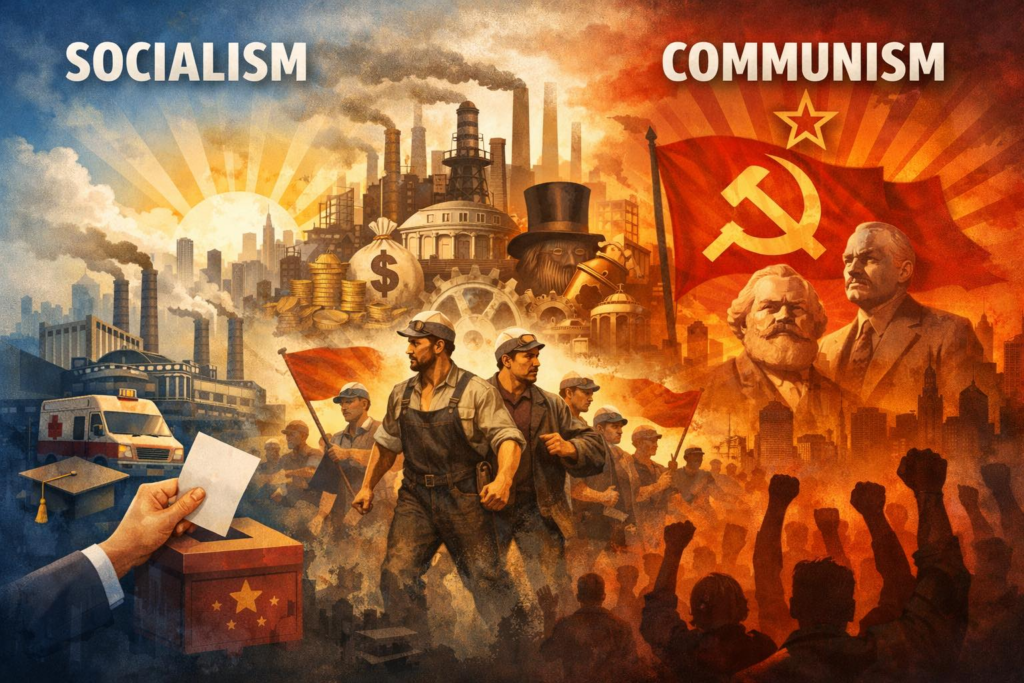
Socialism developed as a broad family of ideas seeking to address the social consequences of industrial capitalism. While socialist traditions vary, many share several common goals:
• Reduction of extreme inequality
• Redistribution of wealth through taxation and social programs
• Public or cooperative ownership of key industries
• Expansion of worker protections and social welfare
In many modern democratic societies, elements of socialism appear not as revolutionary systems but as mixed economies, where markets operate alongside public institutions such as universal education, social insurance, and public healthcare.
3. Marx’s Analysis: Capitalism’s Internal Contradictions
Karl Marx offered a more radical interpretation. He argued that capitalism contains internal contradictions that would eventually produce instability:
• Competition drives consolidation of wealth.
• Workers produce value but receive only a portion of it as wages.
• Economic crises periodically disrupt the system.
• Inequality grows as capital accumulates.
Marx believed that over time workers would develop class consciousness—awareness that their collective interests differ from those of capital owners. This awareness, he argued, would eventually lead to large-scale political transformation.
4. Socialism and Communism in Marxist Theory
In classical Marxist theory, socialism and communism represent different historical stages:
• Socialism: a transitional phase in which major productive resources are collectively or socially controlled, often administered through political institutions.
• Communism: a long-term stage envisioned as a classless society, where economic classes disappear and production is organized around collective needs rather than private profit.
Importantly, Marx’s focus was not the elimination of personal belongings but the transformation of ownership of major productive assets such as factories, large landholdings, and industrial systems.
5. The Vanguard Question and the Problem of Power
Later revolutionary movements introduced the concept of a vanguard party—an organized political group intended to guide workers through revolutionary change. This raised one of the most enduring philosophical dilemmas in political theory:
If a political organization concentrates power in order to create equality, what ensures that it will later surrender that power?
History has shown that this transition is complex. Systems built to correct inequality can themselves generate new concentrations of authority. Thus the debate between capitalism, socialism, and communism is not only economic—it is fundamentally a debate about how power is acquired, exercised, and restrained.
6. Beyond Ideologies: The Recurring Human Pattern
Across history, different systems—monarchies, capitalist markets, socialist states, and revolutionary movements—have all faced the same recurring tension:
• Wealth tends to concentrate.
• Institutions tend to centralize authority.
• Ideals often collide with human incentives.
Because of this, the discussion about socialism and communism is less about predicting an inevitable historical endpoint and more about an ongoing human challenge: how to balance productivity, equality, freedom, and stability in a world where economic structures continually evolve.
Final Reflection
The industrial age raised a fundamental question that still shapes global debates today:
Should economic systems prioritize efficiency and growth, or equality and social protection—and can any society permanently achieve both without concentrating power somewhere?
Every generation attempts its own answer, and the tension between capitalism, socialism, and communism remains one of the central philosophical struggles of modern civilization.
Recent Comments