What if the world is not collapsing – but reorganizing under pressure?
Roder Mortega Yesterday at 7:12 AM · (4) Facebook
Technate of America: A Theory of Survival in a Fragmenting World
What if the world is not collapsing – but reorganizing under pressure?
The transition from a unipolar system to a more multipolar one is not simply a shift in power. It is a shift in how nations think about survival. For decades, globalization encouraged deep interdependence – energy from one region, food from another, manufacturing from another. Efficiency was the goal.
But efficiency has a hidden cost: vulnerability.
Today, that vulnerability is being exposed.
The Stress Fractures of Globalization
Recent years have revealed the limits of global integration:
• Supply chains disrupted by geopolitical conflict
• Energy flows reshaped by sanctions and war
• Fertilizer shortages threatening agricultural stability
• Strategic chokepoints influencing global trade
Interdependence, once seen as a stabilizing force, now carries risk during periods of tension. The global system is not disappearing – but it is entering a phase of stress, fragmentation, and reorganization.
And when systems are stressed, they adapt.
Revisiting the Technate Idea
In the 1930s, amid the economic collapse of the Great Depression, a group of technocratic thinkers proposed a radical idea: the Technate of America.
Their premise was not ideological – it was structural.
They argued that North America, as a continent, possessed:
• Abundant energy resources
• Extensive agricultural capacity
• Significant freshwater reserves
• Industrial and technological potential
From this, they concluded that the region could operate as a self-sufficient economic system, managed through technical expertise rather than traditional political or market mechanisms.
At the time, this idea was dismissed as impractical.
Yet while the original technocratic vision never materialized, its underlying logic – that geography and resources determine resilience – remains relevant.
A Modern Reinterpretation: From Efficiency to Resilience
This is where a thought experiment begins.
What happens if the global system becomes unreliable – not permanently broken, but inconsistent enough that nations begin to hedge against it?
In such a world:
• Countries prioritize domestic production
• Supply chains shorten or regionalize
• Strategic industries are reshored or protected
• Resource security becomes central to policy
North America, by its natural endowments, stands out as one of the few regions capable of approaching relative self-sufficiency.
This does not require political unification.
It does not require a formal “Technate.”
It only requires a shift in behavior:
From maximizing efficiency – to maximizing resilience
Signals Without a Blueprint
Modern geopolitical behavior sometimes reflects this shift:
• Increased focus on domestic energy production
• Strategic interest in resource-rich territories
• Trade realignments and industrial policy
• Emphasis on securing supply chains
These are not evidence of a coordinated plan to build a continental system. There is no official policy – under Donald Trump or any other leader – to create a “Technate of America.”
However, these actions can be interpreted as adaptive responses to uncertainty, rather than steps toward expansion.
Parallel Responses to a Changing World
Different regions are responding to the same pressures in different ways.
For example, Aleksandr Dugin presents a vision of resilience rooted in civilizational identity – arguing that cultural cohesion and geopolitical independence will determine survival in a post-global order.
By contrast, the Technate concept – reimagined today – points toward a different kind of resilience:
• Not based on ideology or identity
• But on resources, systems, and infrastructure
Both perspectives reflect a shared assumption:
The current global order is not fixed – it is evolving.
Energy, Fertilizer, and the Foundations of Power
Modern civilization depends on systems that are often invisible until they are disrupted:
• Energy fuels industry, transport, and electricity
• Fertilizers (nitrogen, ammonia, phosphate) sustain global food production
• Logistics networks connect production to consumption
When these systems are stable, interdependence works.
When they are disrupted, dependency becomes a strategic weakness.
In such conditions:
• Resource-rich regions gain leverage
• Import-dependent regions face increased vulnerability
• Control over production chains becomes a form of power
This is not theoretical – it is already observable in periods of crisis.
Toward a World of Regional Systems
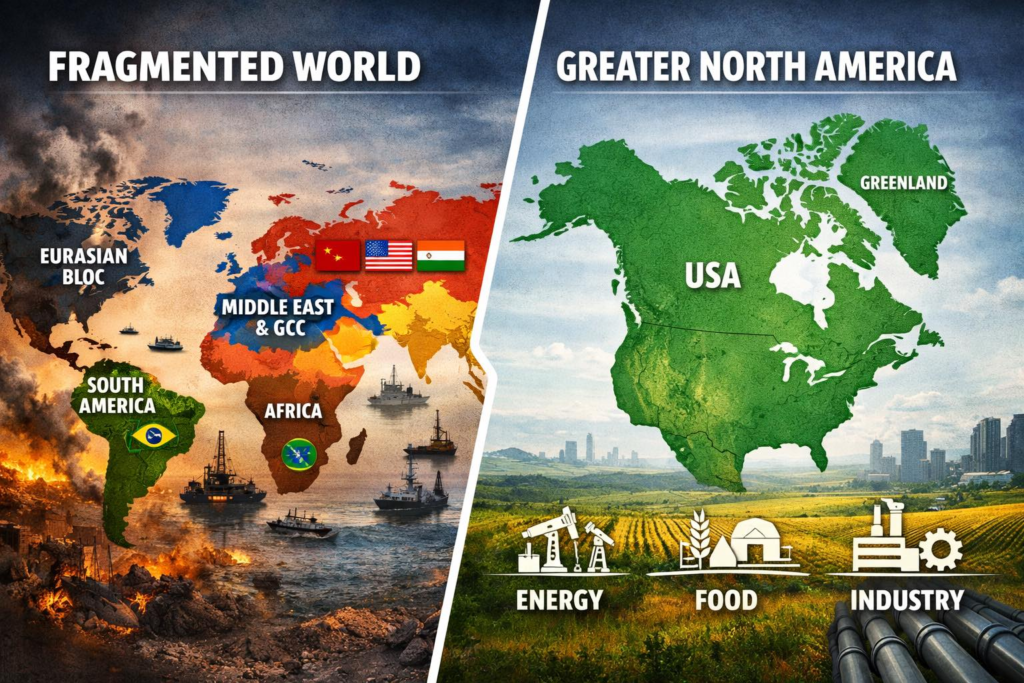
If current trends continue, the future may not be dominated by a single global system, but by a network of regional blocs:
• Each seeking greater control over essential resources
• Each reducing exposure to external shocks
• Each balancing cooperation with self-preservation
Within this framework, North America resembles – functionally, not ideologically – what the Technate once envisioned:
A region with the capacity for relative autonomy in a fragmented world.
Final Reflection
The Technate of America may never exist as a formal system.
But its core insight – that resilience depends on control of energy, food, and infrastructure – has become increasingly relevant.
Globalization is not ending.
But it is no longer unquestioned.
And as the world adapts, nations face a fundamental choice:
Continue to rely on a fragile global network,
or strengthen the systems they can control.
In times of stability, interdependence is strength.
In times of uncertainty, resilience becomes survival.
Recent Comments