MOST RELIGIOUS STATES IN U.S. vs CHRISTIANS?
Geography Explained ·Follow December 6, 2025
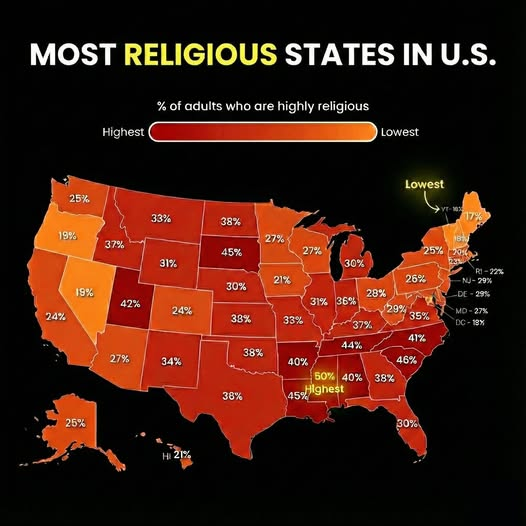
Take a close look at this revealing map visualization that perfectly illustrates the spiritual heartbeat of the nation, showcasing the percentage of adults who consider themselves highly religious across the United States. It is absolutely fascinating to observe the stark contrast between different regions, particularly how the deep, crimson hues dominate the American South, visually defining the famous “Bible Belt” where faith plays a central, daily role in the lives of nearly half the population—with states like Mississippi and Alabama leading the charge with some of the highest percentages in the country. On the flip side, as your eyes drift toward the Pacific Northwest and especially up to New England, the colors fade into lighter shades of orange, highlighting a significant cultural shift where traditional religiosity reports much lower numbers, such as in Vermont and New Hampshire which sit at the lower end of the spectrum. This data isn’t just about numbers on a map; it tells a profound story of history, migration patterns, deep-rooted community values, and how different pockets of the country prioritize faith in the modern era, raising so many interesting questions about how our geography shapes our beliefs, lifestyle, and social connections. I’m really curious to hear from all of you in the comments—does this map accurately reflect the vibe and culture of the state you currently live in, or are you surprised by where your home ranks on this scale?
What is the difference about being religious and being a Christian? – Search
Being religious typically involves following rituals and practices to earn favor with a higher power, while being a Christian emphasizes a personal relationship with God through faith in Jesus Christ.
Key Differences
- Nature of Belief:
- Religious: Often involves adherence to a set of rules, rituals, and traditions aimed at achieving spiritual fulfillment or favor from God. This can include regular attendance at services, participation in ceremonies, and following moral codes based on religious texts.
- Christian: Centers on a personal relationship with God through faith in Jesus Christ. Christians believe that salvation is a gift from God, not something earned through good works or rituals (Ephesians 2:8-9). 2
2 Sources
- Motivation for Actions:
- Religious: Actions are often motivated by a desire to please God or to appear righteous in the eyes of others. This can lead to a focus on external behaviors rather than internal transformation. 2
- Christian: Actions stem from an internal change brought about by faith. Christians believe that good works are a natural outflow of their relationship with God, reflecting His love and grace. 2
- Understanding of Salvation:
- Religious: Many religious individuals may believe that they can earn their way to heaven or spiritual fulfillment through their deeds and adherence to religious laws. 2
- Christian: Christians believe that salvation is not based on human effort but is a free gift from God, received through faith in Jesus Christ. This belief emphasizes grace over works. 2
- Transformation:
- Religious: The focus is often on outward appearances and compliance with religious norms, which can lead to a superficial faith that lacks depth. 2
- Christian: Being a Christian involves a profound transformation of the heart and mind, where the Holy Spirit empowers believers to live in a way that reflects God’s character. 2
4 Sources
- Community and Identity:
- Religious: Identity may be tied to participation in religious institutions and rituals, with a focus on community standards and expectations[^^6^^]. 1
- Christian: Identity is rooted in being a follower of Christ, which may or may not align with traditional religious practices. Christians often emphasize personal faith and community based on shared beliefs rather than mere ritual. 2In summary, while being religious can involve a variety of practices and beliefs across different faiths, being a Christian specifically refers to a relationship with Jesus Christ and the transformative power of faith, which distinguishes it from mere religious observance.
Recent Comments