IS SEPARATION OF CHURCH & STATE MISUNDERSTOOD?
Traci Coston · 19h · (20+) Facebook
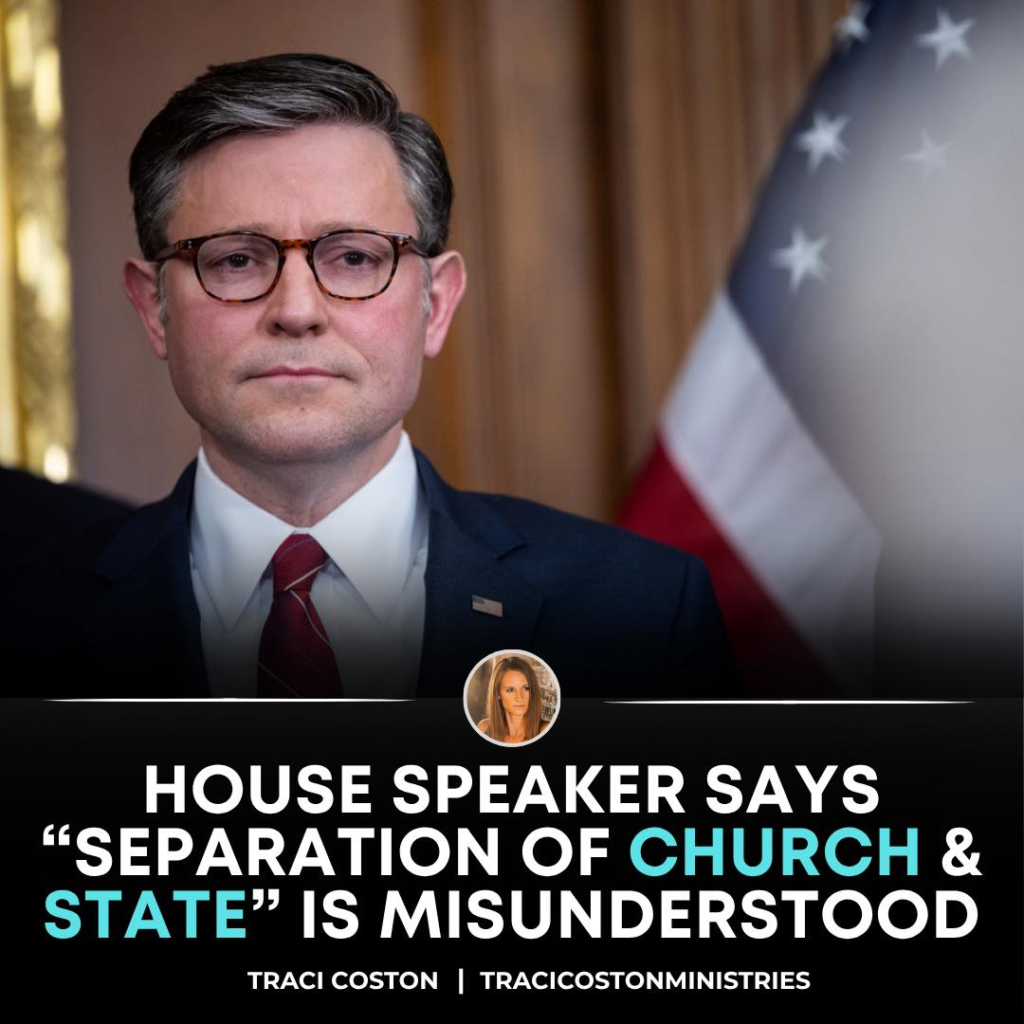
House Speaker Mike Johnson said the phrase “separation of church and state” has been widely misapplied, noting that it does not appear in the Constitution but comes from an 1802 letter by Thomas Jefferson to a Baptist group concerned about government interference in religion.
According to Johnson, the Founders’ intent was not to drive faith out of public life, but to prevent the government from controlling or establishing a national church while protecting citizens’ right to practice religion freely. He argued that moral and religious conviction were viewed by early American leaders as essential to preserving liberty, not something to be confined to private spaces.
Johnson described the present cultural moment as a “spiritual battle” and called on Americans to return to public prayer, saying the nation’s strength ultimately depends on acknowledging God rather than sidelining faith.
IS SEPARATION OF CHURCH & STATE MISUNDERSTOOD? – Search
The phrase “separation of church and state” is often misunderstood, leading to misconceptions about the role of religion in public life and governance.
Historical Context
Common Misconceptions
- The Phrase is in the Constitution: Many believe that “separation of church and state” is explicitly stated in the U.S. Constitution. However, this phrase does not appear in the Constitution; it is a metaphor used by Jefferson to explain the intent of the Establishment Clause and the Free Exercise Clause. 2
- No Religious Expression in Public Schools: A prevalent myth is that students cannot express their religious beliefs in public schools. In reality, students have the right to pray and discuss their faith in school settings, as long as it does not disrupt the educational environment. 2
- Only Jefferson Advocated for Separation: While Jefferson is often cited as the primary proponent of this separation, many early American leaders and thinkers supported the idea of religious freedom and the independence of church and state. 1
2 Sources
Implications of Misunderstandings
Conclusion
Understanding the true meaning of “separation of church and state” is crucial for fostering a society where religious beliefs can coexist with public policy. It is essential to recognize that this separation was intended to protect religious freedom, not to eliminate religious influence from the public sphere. By clarifying these misconceptions, we can promote a more informed dialogue about the role of religion in American life.
Recent Comments